

The most persuasive hamburger in New York City rarely travels far. It crosses three feet of stainless steel, lands on a soft white bun, and reaches the customer while the American cheese is still moving. No carving cart, no tasting flight, no chef's garnish set.
That short journey is the whole argument of this piece. What follows: the counters where it still happens, the mechanics that make it work, and the behavior a first-time visitor needs in order to be welcome twice.
A Hot Steel Surface Outranks a Dry-Aged Cut
The comparison here was framed around the complete eating experience rather than the price or aging of the beef: a short-order cook, a hot flat-top, a soft bun, immediate counter service, and a room whose fixtures have outlasted several waves of neighborhood turnover. Applying that standard once, at the outset, quietly excluded both the steakhouse burger and the modern smash-burger pop-up. Their appeal rests on a different service model, and evaluating them against a fountain counter would flatter neither.
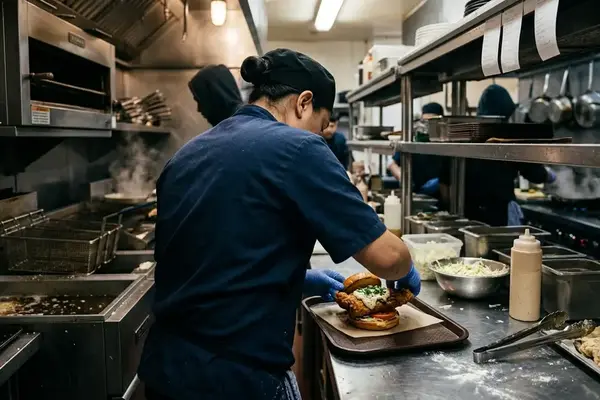
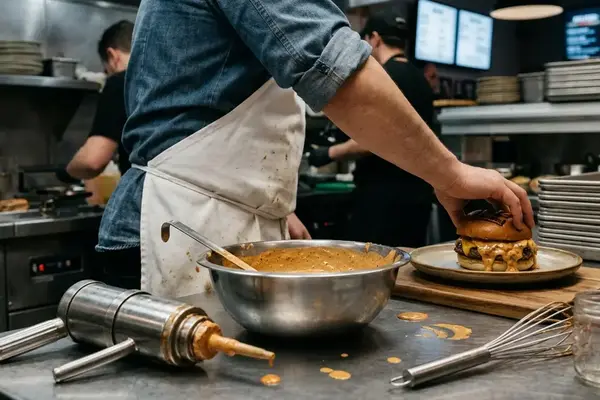
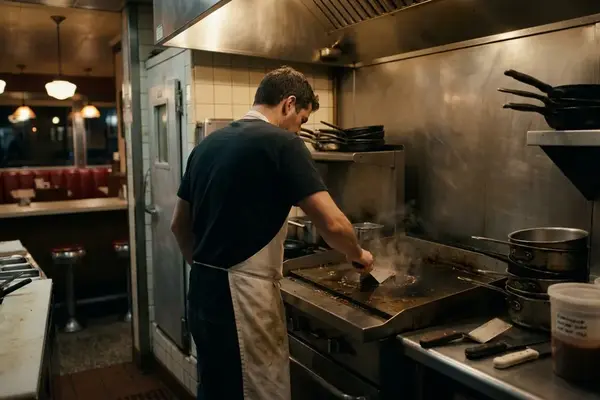
Consider the geography of the plate. At a classic counter, the burger is assembled within arm's reach of the griddle and served the moment the cheese softens and the bun closes. The crust survives that pass in a way it cannot survive a long handoff through a dining room, a heat lamp, and a server's tray.
The Manhattan reference points here open with Lexington Candy Shop in 1925 and close with J.G. Melon in 1972, a documented range pushing 50 years of counter and tavern traditions still operating today. That span is the real inheritance, and it is procedural rather than mystical. Cooks repeat the same patty thickness, the same turn timing, the same cheese placement and bun treatment across hundreds of services. An old griddle does not transfer decades of flavor into today's lunch.
Reading the Room: Formica, Vinyl Stools, and a 400-Degree Flat-Top
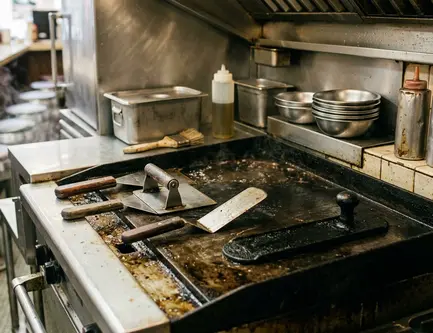
The physical signals and the culinary signals deserve separate scrutiny, so that nostalgia does not stand in for evidence. Worn Formica, fixed vinyl stools that spin, a pie case, stainless steel napkin dispensers, and an open griddle establish the room. A compact burger build and repeatable short-order technique establish the food. Both tests must pass.
What the griddle is actually doing
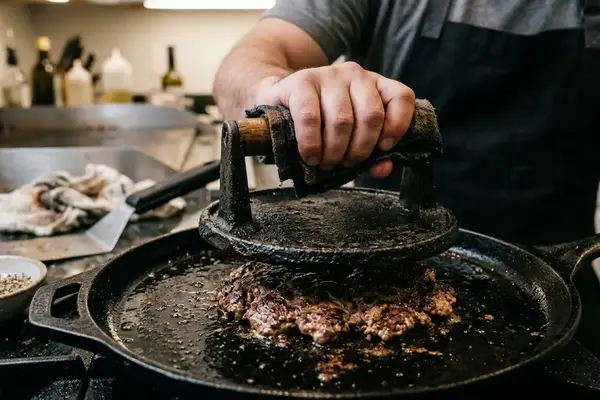
A diner-weight patty commonly falls in the three-to-five-ounce range, light enough to cook fast and heavy enough to stay juicy under a slice of American cheese. Commercial flat-tops used for burgers ordinarily run somewhere around 350 to 425°F. At those surface temperatures moisture leaves the exterior of the patty and browning develops wherever the meat holds direct, dry contact with the steel. For a modest patty, an initial sear of roughly 90 seconds to three minutes before the turn is a plausible service range, shifting with thickness, griddle load, and requested doneness.
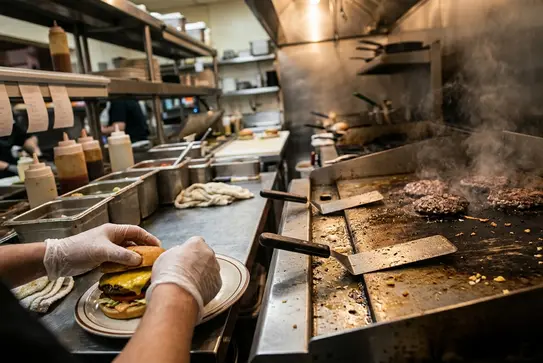
The crust comes from heat, dry contact, pressure management, and rendered fat. It does not come from a dirty griddle. Short-order cooks scrape debris throughout service, and commercial equipment is cleaned after the shift.
The menu as a credential
Constraint is the strongest signal of all. Hamburger or cheeseburger. Raw or griddled onion. Pickles. Ketchup or mustard. A soft white bun. Crinkle-cut or steak fries. A page of composed toppings and signature sauces tells a different story about a kitchen's priorities.
The Patina Boundary
An old address and a retro vinyl stool do not qualify a room on their own. The burger, the service rhythm, and the neighborhood's actual use of the place have to preserve the counter tradition as well.
Four Manhattan Counters Still Running the Old Play
Four institutions were selected using three positive tests: a documented multi-decade history, a room or service pattern that still reads as old New York, and a burger whose structure remains intelligible without elaborate toppings. The group covers the soda fountain, the diner, the tavern, and the neighborhood bar.
Lexington Candy Shop, 1226 Lexington Avenue, opened in 1925 and keeps a working soda-fountain counter behind an interior widely reported as last substantially renovated in 1948. The griddled cheeseburger arrives as a companion to fountain drinks, which is exactly the register the room asks for.
Joe Junior, at Third Avenue and East 16th Street, has run since 1965. The diner is narrow enough that customers hear the spatula strike the griddle before they see the plate. Hand-formed patty, soft bun, American cheese on request.
Corner Bistro, 331 West Fourth Street, dates its neighborhood-bar identity to 1961. The Bistro Burger stacks bacon, cheese, and onion on a thick pub-style patty, and the dark wood room with its compressed ordering rhythm supplies the time-capsule effect.
J.G. Melon, 1291 Third Avenue, opened in 1972. Watermelon imagery, green-check tablecloths, close-set tables, a cheeseburger on a plain bun with pickles, and cottage fries ordered separately. The formula is deliberately narrow and has not widened.
The 2:30 Window
Between roughly 2:30 and 4:30 p.m. on a weekday, the cooks' hand movements are visible and unhurried in a way the noon-to-2 p.m. rush never permits. Go then if the technique interests you as much as the sandwich.
Brooklyn and Queens: The Burger as Neighborhood Fixture
Outside Manhattan the survey was organized by service type rather than by age. A Brooklyn coffee-shop counter, a Queens pub, and a Queens roadside diner demonstrate three distinct settings for the same inheritance. Community function was judged by repeat-customer behavior, counter conversation, and all-day use, not décor.
Mike's Coffee Shop at 328 DeKalb Avenue has served Clinton Hill since 1960: swivel stools, an open short-order station, a griddled cheeseburger, and a menu that runs from breakfast into lunch without changing personality.
Donovan's Pub, 57-24 Roosevelt Avenue in Woodside, opened in 1966 and builds a substantial pub burger associated with charbroiled beef. Mid-century New York burger tradition was never confined to one cooking surface, and Donovan's is the proof.
Jackson Hole's Astoria branch occupies the former Airline Diner at 69-35 Astoria Boulevard, a roadside structure dating to 1952; the restaurant group itself began in 1972. Oversized burgers, chrome-edged room, the large-format branch of the family tree.
The pacing difference is situational rather than borough-wide. A weekday visit between 2 and 4 p.m. shows the community-hub role most clearly, with regulars nursing coffee and staff conducting longer exchanges. That same room compresses fast during weekend brunch or an evening pub rush.
How to Behave at a Twelve-Stool Counter
Counter etiquette follows directly from the bottlenecks: limited stools, one cook holding several tickets, no room for menu conferences, and a single person handling payment while food keeps moving. Readiness, concise speech, and prompt turnover solve nearly everything.
- Decide on cheese, onions, fries, and drink before the server arrives. At a busy counter the useful ordering window may be shy of half a minute.
- Speak in kitchen sequence: burger and quantity, then cheese and doneness, then toppings, then fries and beverage.
- Carry enough cash for the meal and the tip even where cards appear to be accepted. Use the check tray, the register, or the spot the server indicates; never a food-preparation surface.
- Read "no substitutions" and limited doneness options as workflow controls. One concise clarification is fair. Redesigning the build mid-rush interrupts the cook and the three tickets behind yours.
Payment methods, hours, menu items, and seating procedures at independent restaurants change with little notice, so it is worth confirming current details the day of a visit. The cash-and-turnover advice above applies most directly to narrow, high-volume counters; a table-service pub such as Donovan's paces orders and payment on its own terms.
Cash on the Counter
Small bills, ready before the check is requested, prevent the single most common friction point at a vintage counter.
A First Visit, Minute by Minute
Here is the sequence, built backward from the moment the burger hits the pass. Copy it directly.
- Arrive Tuesday through Thursday, 2:30 to 4 p.m. After the lunch peak, before dinner traffic. Pause near the entrance until staff signal whether to take an open stool or wait.
- Spend a minute or less on the posted menu before sitting. Determine whether "double" means two thin patties at this particular establishment, and ask that one question before you begin ordering.
- Deliver the order in a single line: "Double cheeseburger, onions, well-done fries, and a vanilla egg cream." State removals immediately, "no pickle," rather than after the ticket reaches the cook.
- Arrange your footprint. Napkin dispenser, condiments, phone, and coat stay clear of the neighboring stool and the server's landing space.
- Eat promptly. The cheese should still be fluid and the bottom bun should not yet have absorbed everything the patty released. The crust holds better on the short pass from steel to plate, and the repeated hand movements of long-serving short-order cooks attest as much.
- Settle up with small bills. On a $20 counter tab, $4 to $5 is a practical tip when service is attentive. Use the tray or the register.
- Release the stool. Finish the drink and go within roughly three to five minutes when people are waiting. On an empty midafternoon, follow the staff's pace instead of manufacturing urgency.
Run that sequence at Joe Junior on a Wednesday at three o'clock, and the whole tradition compresses into about eighteen minutes: the spatula, the cheese, the check tray, the door.

Leave a Comment