

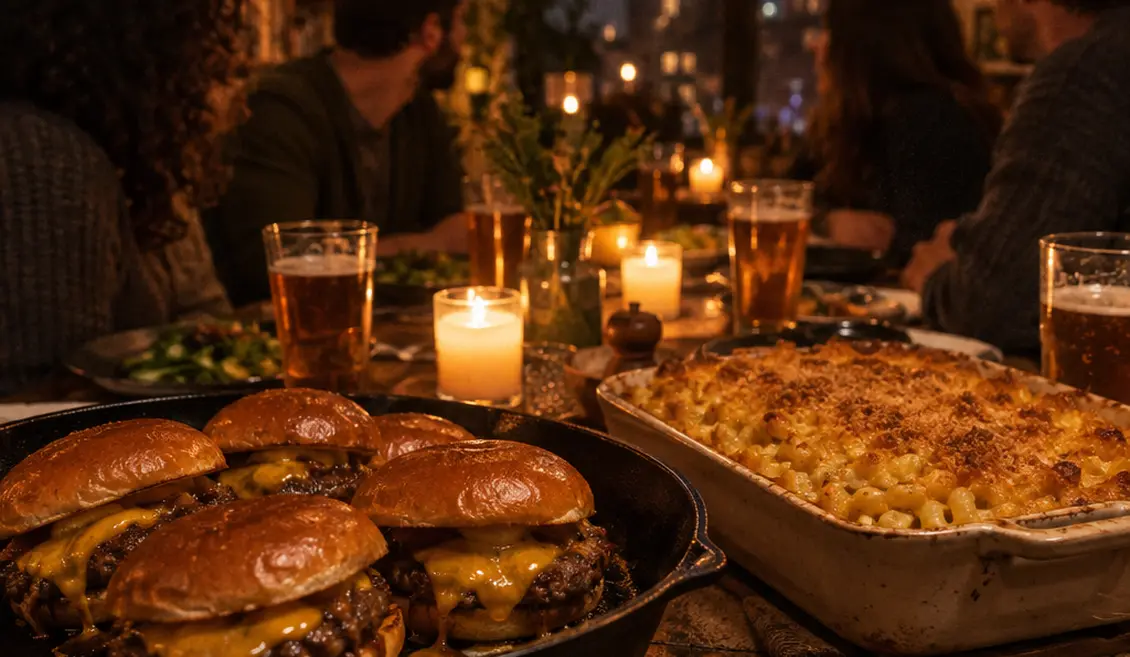
A proper Brooklyn-style bistro burger supper is built around a single, unhurried table service. Everyone sits down together, a platter of thick tavern-style patties lands in the middle of the room, and heavy cast-iron sides stay within arm's reach for the rest of the night. Fast-food smash burger nights turn the host into a short-order line cook flipping lacy edges to order, and backyard cookouts scatter guests across a patio with paper plates. A bistro supper pulls people in close.
The Bedford Avenue Ethos: Thick Patties and Shared Skillets
Anyone who spent evenings along Bedford Avenue in the early days of the Williamsburg dining boom remembers the distinct magnetism of the original DuMont Burger room. It had warm dark wood, close-set tables, zero pretension, and fierce culinary discipline applied to fundamental comfort food. Recreating that dumont legacy at home means translating its core textures and sensory rhythms: deeply browned beef, butter-toasted enriched bread, bubbling cheese, and sharp pickled contrast.
Trying to execute a mechanical replica of a full commercial restaurant menu in an apartment kitchen guarantees stress. Instead, anchor the evening around the structural benchmarks that make this style of nyc dining work at home:
- The Guest Count: Plan the cooking sequence around six to eight diners, scaling the prep to one 6-to-7-ounce raw beef patty per person.
- The Arrival Window: Build in a 20-to-30-minute arrival period for drinks and zero-cook bar snacks before anyone sits down for the main course.
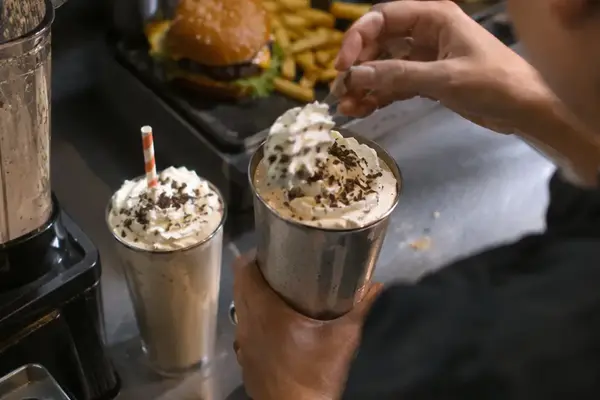
- The Culinary Focus: Keep the menu tight. While boozy shakes were a beloved hallmark of Bedford Avenue counter culture, a seated dinner party flows much better when the kitchen focuses entirely on hot cast iron and crisp, cold drinks.
Sides That Carry the Oven Schedule
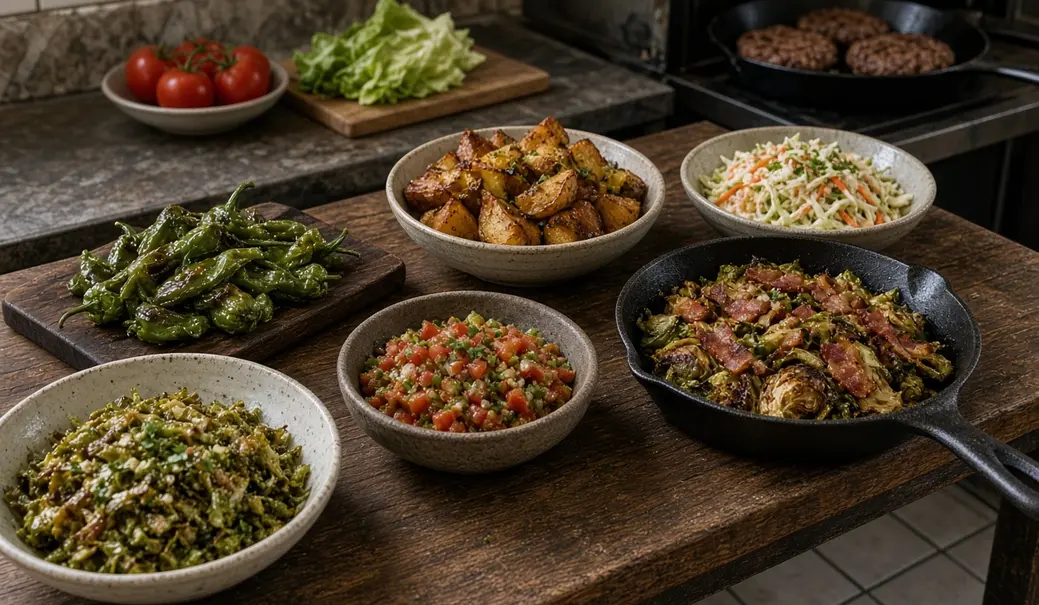
In a small kitchen, sides & appetizers dictate whether the cook actually gets to sit down with the guests. Because thick burgers demand last-minute stove and oven attention, every accompanying dish must either sit comfortably at room temperature, bake mostly hands-off before the beef hits the pan, or come together in thirty seconds flat.
No-Burner Arrival Bites
When guests walk through the door, the stovetop belongs strictly to your pre-warmed skillets and resting caramelized onions. Set out an arrival snack that requires zero active burner space once the doorbell rings. A board of sharp aged cheddar paired with quick-pickled vegetables wakes up the palate immediately. Prepare the quick-pickled vegetables 2 to 24 hours ahead and keep them refrigerated; just before guests arrive, drain a serving portion thoroughly before setting it beside the cheddar. If you want a warm, crunchy element alongside the cheese, toast a batch of spiced nuts or fry a bowl of crispy shallots to pair with raw radishes earlier in the afternoon.
Cast-Iron Gruyère and White Cheddar Macaroni
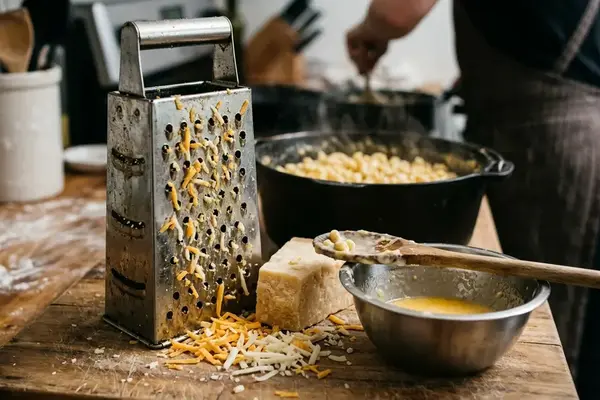
The heavy hitter on the table is a bubbling cast-iron baked macaroni and cheese crowned with a blistered Gruyère and sharp white cheddar crust. You schedule this dish first because its oven timeline dictates when the burgers can finish. For six to eight people eating macaroni as a shared side, use 12 to 16 ounces of dry pasta baked in a 10-to-12-inch ovenproof skillet or an equivalently sized baking dish.
Boil the pasta 1 to 2 minutes short of its package timing before folding it into your cheese sauce, since the noodles continue hydrating and cooking in the oven. For a freshly assembled, still-warm macaroni dish, allow 20 to 30 minutes at 375°F, looking for bubbling edges around the skillet rim rather than relying on the clock alone. Once those edges are actively bubbling, pull the skillet out and hold it on the counter; you will reserve a separate 2-to-4-minute broil for the final browned crust right before serving.
Mustard-Forward Shaved Fennel Salad
With rich beef and a heavy cheese sauce on the plate, the meal requires a bracing, high-acid counterpoint to slice through the fat. A crisp bistro green salad with thinly shaved fennel does the heavy lifting. Whisk the dressing in the bottom of your serving bowl ahead of time: start with 3 tablespoons olive oil, 1 tablespoon red wine vinegar, and 1 to 2 teaspoons Dijon mustard. Wait to toss the greens and shaved fennel into the vinaigrette until the exact moment the burgers come out of the oven so the leaves stay snappingly crisp.
The Butcher Spec: Coarse Chuck, Brisket, and Griddled Brioche
Great homemade burger recipes live or die at the butcher counter. Skip the pre-packaged supermarket tubes and ask your butcher for a coarse chuck-and-brisket grind with approximately 18 to 22 percent fat in the finished mixture. Specifying the exact fat percentage matters just as much as naming the cuts, since lean chuck or trimmed brisket on its own will yield a dry, crumbly patty.
Weigh out 6-to-7-ounce portions and shape each patty gently into a disc approximately 4 inches across and ¾ to 1 inch thick, adjusting the diameter slightly to match the footprint of your buns. Overworking the meat compacts the proteins and gives the burger a bouncy, sausage-like texture. As soon as the patties are formed, transfer them to a parchment-lined tray and keep them refrigerated until the moment they hit the skillet. Never knead salt into the ground beef—salting the interior dissolves muscle proteins and turns the texture tight and springy. Apply kosher salt and coarse black pepper aggressively to the exterior immediately before searing.
Keep the topping architecture disciplined: sharp cheddar or nutty Gruyère, drained quick pickles, and deeply caramelized onions. Start your sliced onions roughly two hours before guests arrive, cooking them for 40 to 60 minutes over medium-low heat with occasional stirring until they reach a deep golden browning rather than stopping when they are merely translucent and softened.
To hold a thick, juicy patty without disintegrating, select structured brioche or potato buns. Butter the cut faces lightly and toast them for 1 to 2 minutes on a warm griddle or skillet, checking the enriched bread frequently because its sugar and egg content browns rapidly.
Brioche Structure Check: A toasted bun acts as a moisture barrier. Griddling the buttered cut face caramelizes the sugars into a thin, crisp seal that absorbs savory meat juices without letting the bottom bun collapse on the platter.
The Two-Skillet Oven Handoff and Smoke Control
Searing eight thick tavern patties start-to-finish on a residential stove is a trap. It fills a small apartment with heavy grease smoke and chains the cook to the range while everyone else drinks wine in the living room. The solution is a two-stage sear-and-roast method: establish a dark, flavorful crust in heavy cast iron on the stovetop, then transfer the patties onto a wire rack set inside a rimmed sheet pan to finish simultaneously in a 400°F oven.
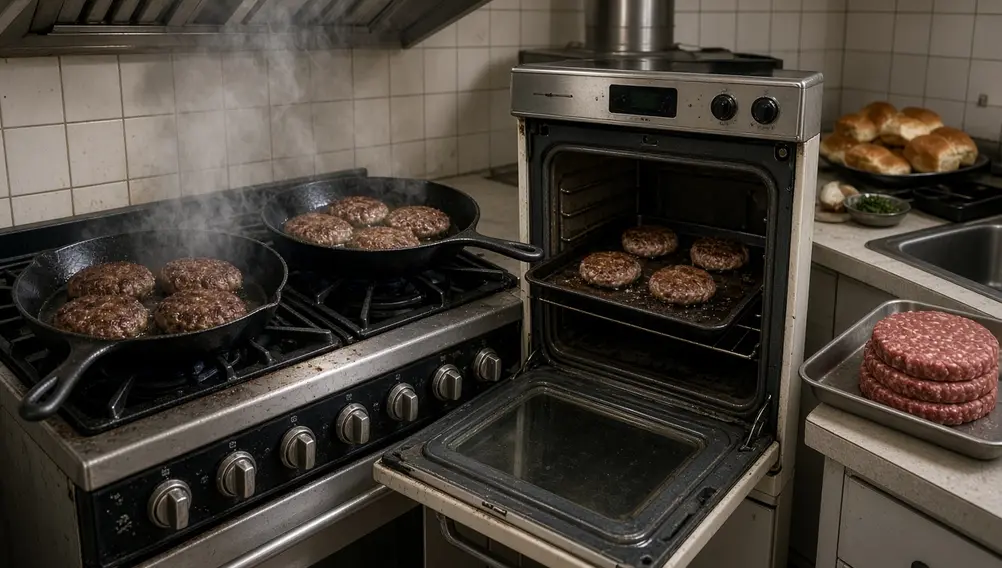
Notice that 400°F is an active cooking oven, not a low-temperature holding cabinet. In typical 10-to-12-inch cast-iron skillets, cook two thick patties per pan to prevent crowding and steaming. Cooking six to eight burgers therefore requires two searing rounds across two pans.
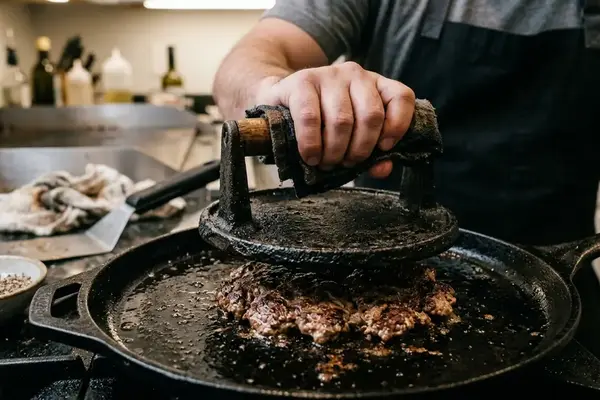
Before you touch a burner dial, set up your kitchen ventilation. Turn on an externally vented range hood before heating the skillets, crack open a nearby window where practical, and keep all smoke alarms active. Keep cooking-area task lighting on throughout searing and plating so you can clearly judge pan heat and crust color, even when the dining room lighting is dimmed. Instead of heating empty cast iron until it smokes, bring the pans up over medium-high heat with a thin film of refined high-heat oil.
Sear the seasoned patties for approximately 1½ to 2 minutes per side until a deep mahogany crust forms, transferring each batch directly onto the wire-racked sheet pan. Once all six to eight patties are on the rack, slide the sheet pan into the 400°F oven. Begin checking the burgers after 4 to 6 minutes in the oven. Total oven time can extend beyond that window depending on your oven's recovery speed and starting meat temperature, and while this two-stage roast delivers an exceptionally juicy center when pulled right on target, home cooks should rely on an instant-read thermometer and follow USDA safe minimum internal temperature guidelines for ground beef rather than judging doneness by interior color. Lay sliced cheddar or Gruyère over each patty during the final 1 to 2 minutes of oven cooking, then pull the sheet pan and rest the finished patties for 3 to 5 minutes while the macaroni topping browns under the broiler.
A Backward Plan for One Shared Burger Service
To land the burgers, bubbling macaroni, and crisp salad on the table at the exact same minute, work backward from T (the moment the platter reaches the table):
- T−150 to T−120 minutes: Slice and start the onions over medium-low heat (40 to 60 minutes total cook time). Assemble the macaroni and cheese components, whisk the salad vinaigrette in the bottom of the serving bowl, and verify that your rimmed sheet pan, wire rack, and two 10-to-12-inch skillets are clean and ready.
- T−60 minutes: Shape the 6-to-7-ounce patties, set them on a tray in the refrigerator, and butter the buns.
- T−45 minutes: Toast the buttered bun faces for 1 to 2 minutes on a dry skillet and set them aside at your plating station. Preheat the oven to 375°F and slide the assembled macaroni skillet onto the center rack for 20 to 30 minutes until the edges bubble.
- T−30 minutes: Guests arrive. Drain a portion of quick-pickled vegetables to serve beside the sharp cheddar, pour the first round of drinks, and let the oven do the work.
- T−15 minutes: Pull the bubbling macaroni from the oven (keep it on the counter) and raise the oven temperature to 400°F. Turn on the externally vented hood, open a window, and heat your two cast-iron skillets over medium-high heat with a thin film of oil.
- T−12 minutes: Season the cold patties generously with kosher salt and coarse black pepper. Sear in two rounds across the two pans (two patties per pan, 1½ to 2 minutes per side), transferring each seared burger to the wire rack over the sheet pan.
- T−6 minutes: Slide the racked burgers into the 400°F oven. Check internal temperature starting at 4 minutes, adding cheese during the final 1 to 2 minutes of roasting.
- T−3 minutes: Pull the sheet pan of cheese-capped burgers to rest for 3 to 5 minutes. Switch the oven to broil and slide the macaroni back in for 2 to 4 minutes, watching continuously until the Gruyère and cheddar crust blisters. Toss the greens and shaved fennel with the mustard vinaigrette.
- T−0 minutes: Transfer the rested patties onto the toasted bottom buns on a warmed platter, pull the bubbling macaroni from the broiler, and carry everything to the table in one coordinated sweep.
Pouring High-Acid Drinks and Setting the Room
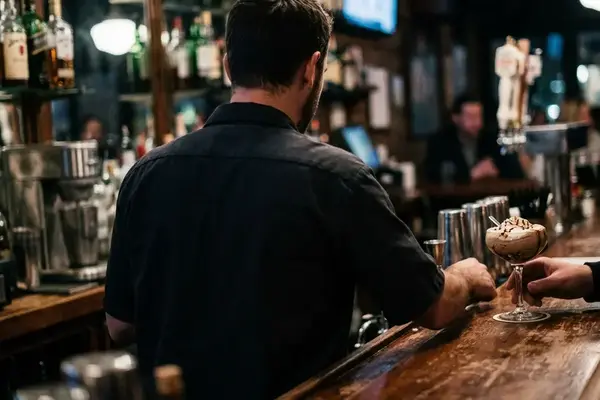
A meal built around 20-percent-fat beef and baked Gruyère pasta needs beverages that scrub the palate clean after every bite. Skip heavy, oaky cabernets and syrupy imperial stouts. Pour drinks built for refreshment and snap: crisp local pilsners, hoppy pale ales, bone-dry cider, or a lightly chilled, high-acid red wine. If you are pulling corks on a Beaujolais or a Loire Valley Cabernet Franc, aim for a cellar serving temperature of approximately 55 to 60°F rather than the ambient temperature of a warm apartment; fifteen minutes in the refrigerator before guests arrive tightens up the fruit and highlights the wine's natural acidity. Set out carafes of cold water alongside the first drinks, and always stock an unsweetened sparkling water with lemon wedges or a nonalcoholic bitter aperitivo so non-drinkers get that same bracing palate cleanser.
Set the dining table as a home interpretation of early-2000s Williamsburg neighborhood dining—warm, tactile, and completely unfussy. Roll out a strip of brown butcher paper down the center of the table instead of ironing a stiff linen tablecloth. Set out sturdy, mismatched bistro glassware and real cloth napkins. Most importantly, place heavy wooden trivets in the center of the table for the macaroni skillet and any hot serving vessels before guests sit down so you aren't scrambling with a scorching pan in your hands.
Dial down the dining-room overhead lights while keeping your kitchen task lighting bright. If you light the table with unscented taper candles, secure them exclusively in stable, purpose-made holders rather than balancing them in empty wine bottles, and keep the flames well clear of butcher-paper runners, cloth napkins, and reaching hands. Queue 90 to 120 minutes of music—warm soul, jazz, or low-key indie vinyl—before the first guest knocks, keeping the playback volume low enough that conversation across the table never requires raised voices.
Skip the Custom Orders and Serve the Platter Open-Faced
Here is the single non-negotiable rule for hosting a bistro burger supper: never take individual custom topping orders at a dinner party. Asking eight people how they want their burger dressed turns your dining room into a chaotic diner counter and guarantees that the first patties go cold while you fuss with condiments.
Commit to one confident house burger. Arrange all six to eight cheese-capped patties on toasted bottom buns across one large warmed platter—or two smaller warmed platters—without stacking them, laying the toasted top buns right alongside in an open-faced presentation. Put the warm caramelized onions in a single ceramic crock and the well-drained quick pickles in a separate bowl so acidic pickle brine never puddles onto the toasted brioche.
While the burgers finish their 3-to-5-minute rest and the macaroni blisters under the broiler for its final 2 to 4 minutes, toss the fennel salad. Use heavy oven mitts to move the screaming-hot cast-iron macaroni skillet straight onto its waiting wooden trivet, and immediately slip a dry protective towel or leather sleeve over the hot iron handle so no one grabs it bare-handed at the table. Carry the open-faced burger platter, the bubbling skillet, and the mustard-dressed greens out in the exact same service window, sit down in your chair while the food is piping hot, and let the table dig in together.

Leave a Comment