

What's Inside
- The Sidewalk-to-Seat Problem on a Family Burger Night
- Building the Evening Around a Park and a Subway Line
- Securing the Early Booth: Reservations, Walk-In Lists and the Five O'Clock Window
- Steps, Vestibules and Changing Tables: Calling the Host Stand
- Splitting Patties, Firing Fries and Adding Up the Real Check
- Your Saturday in Brooklyn, From Playground Gate to Paid Check
The Sidewalk-to-Seat Problem on a Family Burger Night
A family burger night in New York can fail long before anyone takes a bite. It starts on a narrow sidewalk, where a queue forms outside a beloved tavern and two hungry children lean on a stroller that has nowhere to go. It continues at the door, when the host points toward a high-top wedged beside packed barstools. By the time a premium-priced patty arrives, one child is in tears, the other is under the table, and the adults are asking for boxes.
That collapse begins in the gap between the sidewalk queue and the high-top assignment. A reservation time, on its own, solves neither stroller storage nor children's seating.
The reverse outcome is worth planning for. When the logistics hold, the evening delivers what generations of Brooklyn diners promised: a hot burger the parents actually eat warm, a booth where the children sit safely, and fries that arrive before patience runs out. The mid-century lunch counter and the modern gourmet tavern share this lesson. The room shapes the meal as much as the grill does.
Five variables decide the night: reservation timing, physical layout, menu adaptability, an honest cost calculation, and the transit route home.
Building the Evening Around a Park and a Subway Line
Families tend to start with the burger and work outward. The sounder method runs the other way: choose the park-and-transit pairing first, then compare the burger menus within walking distance.
Brooklyn offers two dependable starting points. McCarren Park sits between Williamsburg and Greenpoint, surrounded by casual restaurants that range from smash-burger counters to full-service taverns. Fort Greene Park anchors a separate neighborhood with its own mix of brownstone dining rooms and corner spots. In both cases, the useful criteria are sidewalk width, the density of casual restaurants, and the distance to green space. Online burger hype ranks well below all three.
A park before dinner lets children burn off energy so they can sit still at the table. A park after dinner gives an overtired family a slow walk to decompress. The NYC Parks playground locator identifies which playgrounds sit close to a given restaurant cluster.
Walking the Blocks Before the Kids Do
Map labels mislead. Measure the walk from the playground gate the family will actually use, and inspect the blocks between the station, that gate and the restaurant for crossings, sidewalk pinch points and scaffolding or construction.
Map the subway return before leaving home. Direct lines beat transfers, and a heavy stroller makes elevators decisive: the MTA publishes accessible-station information and a live elevator-status page. Check it once before departure and again before the trip home, since an outage can appear between the two.
Securing the Early Booth: Reservations, Walk-In Lists and the Five O'Clock Window
The target is the window between 5:00 and 5:45 PM, when the dinner shift opens and before the adult and bar crowd settles in. Treat that window as something to investigate. Restaurants publish different dinner hours, and the kitchen may begin serving later than the doors open, so confirm when food actually starts leaving the pass.
New York burger spots generally handle seating in one of three ways:
- Full-service taverns take reservations and assign tables in advance, the most controllable option for a family.
- Counter-service spots seat customers after they order, with fast table turnover but little guarantee of a booth.
- Walk-in-only neighborhood institutions run a list, which rewards arriving early and punishes arriving with a fading toddler.
When booking a reservable room, state the full party size including children, and specify the number of high chairs and booster seats. Request a standard-height table in writing; that note is what keeps the host from allocating a high-top. Two further questions matter: whether the restaurant seats incomplete parties, and whether the reservation carries a stated dining-time limit.
For a 5:00 PM booking, plan to check in at 4:50 to 4:55 PM and ask where the family should wait.
Steps, Vestibules and Changing Tables: Calling the Host Stand
Restaurant photographs reveal the questions; the host stand supplies the answers. Before booking, scan entrance and dining-room images for brownstone stoops, basement steps, heavy double vestibule doors and narrow aisles between tightly spaced two-tops. Then call.
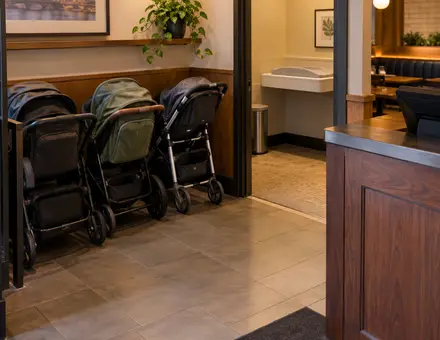
The layout check covers four points: the entrance, stroller storage, the route to the table, and the restroom. A short phone script covers them:
- "Must the stroller be folded at the entrance, and where will it be stored during dinner?"
- "Is there booth or corner seating available for our party?"
- "Does the route to our table or to the restroom include stairs?"
- "Which restroom has the changing table, and can any caregiver use it?"
Booth Before Booking
Settle the seating and stroller answers on the phone before confirming the reservation time. A perfect slot paired with a high-top and no stroller corner still ends the evening early.
Backyard patios and outdoor dining structures earn consideration in mild weather. Open air absorbs a child's volume, and there is often more room to park a stroller. A patio booking still needs verification of its own, however: confirm the entrance route, where the stroller goes, and what happens to the table if it rains.
Splitting Patties, Firing Fries and Adding Up the Real Check
A printed kids' menu signals goodwill, but flexibility matters more. Read the burger descriptions and side listings together, then ask the kitchen to confirm three things before ordering: a plain single-patty cheeseburger, toppings served on the side, and any cutting or sharing arrangement.
Splitting deserves precision. A double smash burger normally contains two patties, so turning it into two separate sandwiches requires a second bun and the kitchen's agreement. Burgers made at home work the same way, and a polite request usually lands better when the server understands the mechanics.
One-Sixty for the Kids
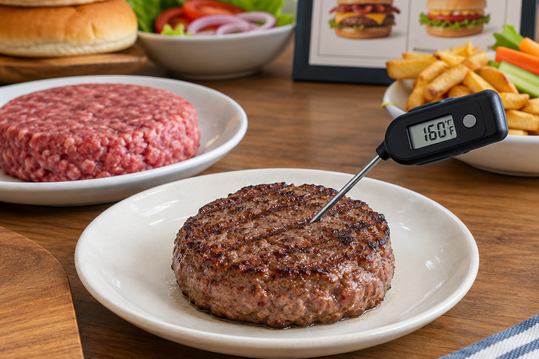
Order children's ground beef cooked to 160°F, the USDA safe minimum internal temperature for ground beef. Color alone is not a reliable doneness test, so state the temperature rather than asking for "well done."
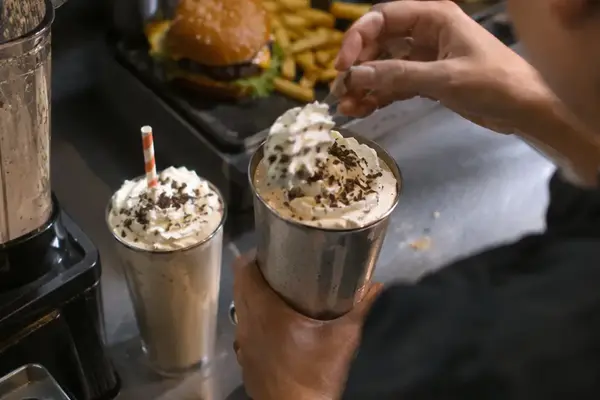
Speed is the other half of flexibility. A thick tavern patty cooked to temperature takes time, and no menu promises a fixed number of minutes. Ask on sitting down which starter can arrive first. A basket of fries or a plate of pickles from the sides list buys the calm that the main course needs. Save the boozy shakes for an adults' night; the sugar arrives at the wrong moment of a family evening.
The Arithmetic Behind the Final Check
The burger's menu price is the least reliable guide to the final bill. Count every separately priced item in the subtotal: fries listed apart from the burger, children's drinks, extra cheese and any other additions. Restaurant food in New York City generally carries 8.875% sales tax. An 18 to 20% gratuity on the pretax subtotal is a conventional full-service planning allowance, though the bill should be inspected for an included service charge before tipping.
A sample calculation shows how the pieces stack:
- Taxable food-and-drink subtotal: $70.00
- Sales tax at 8.875%: $6.21
- Tip at 20% of the pretax subtotal: $14.00
- Total: $90.21
Budget From the Bottom
Start the estimate from the subtotal including sides and drinks, then add tax and tip. A budget built on two burger prices will come in short by the cost of the fries alone.
The Pre-Booking Host-Stand Check
- Confirm the dinner kitchen's opening time and the seating or reservation policy.
- Give the complete party size and request a standard-height table with the required child seating.
- Confirm entrance steps, stroller-folding rules and where the stroller will be stored.
- Ask about stairs on the route to the table and restroom, and locate the changing table.
- Confirm the kitchen can prepare a plain single-patty cheeseburger with toppings on the side.
- Ask whether incomplete parties are seated and whether a dining-time limit applies.
Your Saturday in Brooklyn, From Playground Gate to Paid Check
Here is how the pieces combine for a Saturday evening with two children and a folding stroller. Everything starts with the phone call: you confirm a 5:00 PM standard-height booth, a corner for the folded stroller, and the kitchen's willingness to make a split plain cheeseburger. Then you build the afternoon backward from that reservation.
- 4:00 PM. You arrive at a playground three blocks from the restaurant, having taken a direct subway line to a station whose elevator you checked on the MTA status page that morning. The children get forty-five minutes of climbing and running.
- 4:45 PM. You leave through the gate you measured from, not the one on the park map, and cover the three blocks along the route you walked in advance.
- 4:50 PM. At the entrance you fold the stroller before the 5:00 PM rush, check in for the booth, and hand the stroller to the corner the host named on the phone.
- 5:00 PM. Seated, you ask the server to fire a shared basket of crinkle-cut fries immediately. You order a gourmet tavern burger for yourself and a single-patty plain cheeseburger, cooked to 160°F, split for the two children with toppings on the side.
- 5:15 to 5:45 PM. The fries carry the children until the burgers land. Everyone eats, and one adult handles the restroom visit at the changing table you located in advance.
- 5:45 PM. In the final stretch of the meal you request the check rather than waiting for everyone to be ready. You add it up the way the sample showed: subtotal including fries and kids' drinks, 8.875% tax, then tip on the pretax figure.
- 6:00 PM. You unfold the stroller and recheck the elevator status before walking back to the station.
That six o'clock exit is a planning target built around the confirmed booth, the shared plain cheeseburger and working subway elevators. A slow kitchen can push departure past 6:00 PM, which is exactly why the check request at 5:45 matters: it keeps a late burger from becoming a late bedtime, and it sends you home having eaten your own tavern burger while it was still hot.



Leave a Comment